
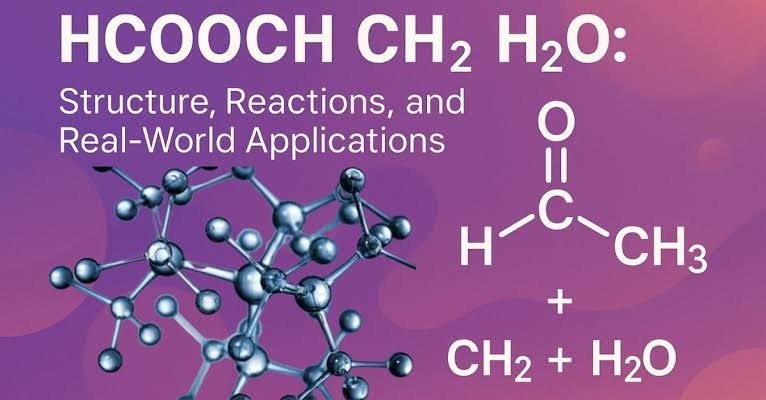
The term HCOOCH CH2 H2O can look confusing, especially for students searching for a chemical formula or reaction online. At first glance, it appears to describe a compound containing a formate group, a carbon fragment, and water. However, this notation is not a standard chemical formula for one clearly defined compound.
In many chemistry discussions, the expression is connected with methyl formate (HCOOCH₃) and its reaction with water. The scientifically useful reaction is the hydrolysis of methyl formate, which produces formic acid and methanol.
What Does HCOOCH CH2 H2O Mean?
As written, HCOOCH CH2 H2O does not represent a conventional, well-defined chemical molecule. Chemical formulas must show the correct number and arrangement of atoms. Simply placing HCOOCH, CH₂, and H₂O together does not identify one stable compound.
A likely intended topic is methyl formate reacting with water. Methyl formate has the correct formula HCOOCH₃ and belongs to the ester family.
Therefore, when researching this keyword, it is important to distinguish the search phrase from the actual chemical formula.
What Is Methyl Formate?
Methyl formate, also known as methyl methanoate, is a simple ester. Its molecular formula is HCOOCH₃, and its structure contains a formate group connected to a methyl group.
The compound can be represented structurally as:
H–C(=O)–O–CH₃
Like other esters, methyl formate can participate in hydrolysis. In this process, water interacts with the ester and helps break its structure into smaller molecules.
This makes methyl formate useful for explaining an important concept in organic chemistry: the reaction between an ester and water.
HCOOCH CH2 H2O Reaction
If the intended meaning is methyl formate plus water, the balanced reaction is:
HCOOCH₃ + H₂O ⇌ HCOOH + CH₃OH
The reactants are methyl formate and water. The products are formic acid (HCOOH) and methanol (CH₃OH). thematcharead.com
This process is called ester hydrolysis because water participates in breaking the ester bond.
The reaction can also be considered reversible under suitable conditions. The direction of the reaction depends on factors such as temperature, water concentration, and the reaction environment.
How Does Ester Hydrolysis Work?
The basic idea of hydrolysis is simple: water helps split a chemical structure into different products.
In methyl formate hydrolysis, water interacts with the carbonyl portion of the ester. The carbonyl carbon is electrophilic, meaning it can attract a nucleophilic species such as water.
The reaction then passes through intermediate steps before the original ester structure is converted into formic acid and methanol.
For beginners, it is enough to remember this general pattern:
Ester + Water → Carboxylic Acid + Alcohol
For methyl formate, that becomes:
Methyl formate + Water → Formic acid + Methanol
This is the key chemistry behind the search term.
Why Is Water Important?
Water is not simply a solvent in this reaction. It supplies atoms that become part of the final products during hydrolysis.
The reaction demonstrates why water is important in many chemical transformations. Hydrolysis reactions occur in organic chemistry, biochemistry, environmental chemistry, and industrial processes.
The exact speed of hydrolysis depends on the conditions. Without suitable reaction conditions, ester hydrolysis can be relatively slow. Acidic or basic environments can influence the reaction rate and pathway.
Formic Acid and Methanol
The two main products of methyl formate hydrolysis are formic acid and methanol.
Formic acid (HCOOH) is the simplest carboxylic acid. It has applications in areas such as chemical manufacturing, agriculture, and industrial processing.
Methanol (CH₃OH) is a simple alcohol widely used as a chemical feedstock and solvent. It is also important in the production of several industrial chemicals.
The formation of these two compounds explains why methyl formate hydrolysis is an important reaction to understand.
Common Formula Confusion
One common mistake is treating HCOOCH₂ as though it were the same as HCOOCH₃. These formulas are not interchangeable.
If the intended compound is methyl formate, the correct formula is:
HCOOCH₃
The CH₃ group is important because it identifies the methyl portion of the ester. Writing CH₂ instead changes the atom count and does not describe methyl formate.
For academic work, laboratory notes, and educational content, using the correct chemical formula is essential.
Why This Reaction Matters in Chemistry
The reaction connected with HCOOCH CH2 H2O provides a simple example of ester chemistry. Students can use it to understand several important concepts at once, including functional groups, hydrolysis, reversible reactions, nucleophilic attack, and product formation.
It also demonstrates the importance of writing chemical formulas accurately. A small difference in a subscript can change the identity of a compound.
For students searching for methyl formate hydrolysis reaction, the balanced equation provides a much clearer starting point than the informal HCOOCH CH2 H2O notation.
Safety and Proper Identification
Chemical formulas should always be verified before attempting a laboratory reaction. A confusing online expression should not be treated as the name of a chemical reagent.
Methyl formate, methanol, and formic acid are distinct substances with their own physical and chemical properties. They should be handled according to appropriate laboratory safety procedures.
Understanding the correct identity of a substance is especially important when working with volatile, flammable, or corrosive chemicals.
Conclusion
HCOOCH CH2 H2O is best understood as a confusing or informal search expression rather than the formula of one clearly defined chemical compound. The scientifically relevant chemistry commonly associated with the term involves methyl formate (HCOOCH₃) reacting with water.
The key hydrolysis equation is:
HCOOCH₃ + H₂O ⇌ HCOOH + CH₃OH
In simple terms, methyl formate reacts with water to produce formic acid and methanol under suitable conditions. Understanding this reaction helps students recognize ester hydrolysis and, more importantly, shows why accurate chemical notation matters in organic chemistry.